When you’re traveling abroad, you want to fully understand the place you’re in. Food, history, culture, politics, art, the weight of its geography, all of it.
While traveling you may mind connecting with locals because of obvious language barrier.
But if you take the risk and befriend them, they will take you to places you never would have found on your own.
I got the chance to meet a guy near my accommodation. Turned out he is a history and art student, one who’s spent ten years building historical maps and short documentary-style videos for YouTube and local communities. I learned more from him than I expected and then from his mom, an English and music teacher at a primary school.
Today, they invited me to a music class run by the school’s faculty, for kids who spend two hours a week learning Javanese music called Gamelan.
When you walk into the music lab and the instruments look like nothing special at first, a row of dusty brass metal. But the moment you start exploring each one, it clicks. Seven different instruments, all built around the same pattern of music notes, while producing unique noise.
I was a random guest, no training, no formal lesson in the history or the how-to. And they still handed me a seat and a set of notes to allowing me to get familiar with two similar instruments.
At first, it felt like too much. But nothing stays that way once you sit with it long enough. You have to watch both instruments at once, memorize a run of sixteen notes in one go, then control the instrument with one hand while you strike it with the other.
It was hit and miss most of the time. But I loved the rhythm instrument was building. After the session, the kids came up to meet me, warm and welcoming, some of them stopping by earlier just to watch and cheer while I was getting comfortable.
I enjoy talking to random locals and I love it almost all the time. Thinking through too much about everything while you are there to sink in, doesn’t make sense to me. I try to vibe along the people who fits into my funnel of curiosity and I love it. A little pre-research and open mind gets you far more than you are owed as a visitor.
That’s the whole trick. Make yourself available to actually know a place. You can only do that if you let yourself get soaked in local experience.
So say more yeses, as you will get to experience things you never imagined.
“How far you can run away thinking; you look dumb, and you are not enough?”
That question still finds me, even now, in every hour I spend away from doing something. It was hard to face back then. It’s not much easier today.
I trace it back, sometimes, to childhood. The same feeling, showing up in a new shirt each time. Should I be doing this. If I don’t, what does that make me? I still catch myself mid-thought, asking it.
It started young. I was bad at writing. Bad at memorizing. I wanted to be better than everyone around me, badly.
One thing pulled me in anyway. Speaking a foreign language. English, specifically.
I didn’t know where to start. I just knew I wanted to be different, in at least one way, one day. I wanted to make it mine, even by looking dumb. or being called an anomaly. At the same time, i was scared too, of failing loud enough for everyone to notice.
Back then, I was doing something nobody in my circle bothered with, and I felt small for it. Small, but stubborn enough to keep reading whatever might sharpen my speaking and pronunciation. I took whatever good I could find and tried not to let the criticism cut too deep inside me. I started trying different accents, along with one or two classmates.
Everyone else called me the dumbest kid in the room.
Why? I wasn’t chasing girls. Weren’t cracking jokes at anyone’s expense. Wasn’t flattering teachers to stay in their good books. I was the one standing up to ask for a lesson revision. I was always first in line for the whole class’s punishment.
I made it through primary school, anyway, carrying that nimble love for writing obvious English with me. Then I met a humble high school teacher who helped me practice, in my ways.
I ended up being the highest-scoring student in the whole town. Breaking a fifty-year record, studying the entire curriculum in English while I did it. Nobody believed it, not even my parents.
After years of humiliation, and a struggle I still feel in my chest sometimes, the time I spent on this love for language finally caught up with me. My standing in the neighborhood flipped, almost overnight.
The pattern started and kept me through it. I finished my master’s in advanced tech, on scholarship. Started working international gigs. Kept practicing my speaking so often that, somewhere along the way, on a trip through Asian countries, strangers began stopping me on ‘you have such a good accent, how did you learn?’
You don’t look European nor like other Asians. But you speak like you carry a British accent. One of the finest compliments I ever taken. Hearing it, over and over, made one thing clear, none of it was possible without getting comfortable in looking foolish, and a little unhinged, along the way.
The realization is a simple one, even now. Be unlike the room you are in. Pave your own path and make it yours. You can regulate your own mind but can’t do a thing to help else’s.
It’s their decision and not in your hands at all.
Every person who was the cheerleaders of my dumbness couldn’t made past high school.
When I sit with myself now, and think about what a person is actually worth, I keep landing in the same place. Living small when you were built for more, is like taking pennies when you were owed millions.
Be an extra ordinary by doing ordinary things more often than people do.
The psychology behind brand differentiation and why it’s not doing what you think.
I used to believe differentiation was everything a brand needed to pop. Look different, get better at memes & social media and sound a bit different than competition, and you are all set for win.
Turns out that’s the wrong metric to sleep on. I only found this out by digging into what the psychology actually says, not what the marketing viral posts or textbooks promise us with catchy hooks.
The question i kept recalling:
“Does brand differentiation make us more familiar and likeable, or are we are just hoping that being “different” will do that job for us?”
The evidence backs the second;
Start with building familiarity, build a bit of warm-fuzzy feeling, be easy to recognize and let people stumble onto your differentiation themselves, ideally after they’ve already bought you.
That said, blinding following the notion of “being different” as the headline is chasing the vanity metric with no growth promise. Follow this simple way to write the obvious messaging to create a consistent familiarity.
What gets brands picked then?
Two boring, unglamorous things:
Familiarity We trust and prefer stuff we recognize. It’s a straight-up brain bias, not something to associated with personality.
Emotional Familiarity Feeling vaguely good about a brand, not that “I love this brand,” but a mild warm feeling instead of a cool one. That tiny difference does most of the work.
Neither of the above cares whether you are different. Honestly, being unfamiliar and “novel” can work against you, because people’s brains lean toward the status quo, not away from it.
Btw, where did “be different” come from?
It started as a 1930s economics idea about pricing power. Multiple marketing textbooks picked it up decades later and rebranded it into a sloppy and meaningless narrative of “this is how you win customers“. The actual data never backed the second half of the story.
Sadly, every serious study since the 1990s been trying hard to associate differentiation to profit and margin, not to ‘why more people picking your brand in the first place’. shared in Journal of Marketing Management by Byron Sharp and John Dawes.
Where brand differentiation actually pays
It works after someone has already bought from you. A real, functional brand difference improves the experience not the shelf life, which builds satisfaction, which leads to emotional warmth, which then lets you hold or raise price, that ultimately helping you win with margin.
To summarize; the real job is not making your brand look “we are like nobody else”. It is making your brand familiar and likeable enough to get picked and different enough that once picked, then it keeps people paying for it.
I have read loads of marketing books between college and my professional life.
Influence by Cialdini. Building a StoryBrand (on brand face marketing copy) by Donald Miller. This Is Marketing, All Marketers Are Liars and The Dip, by Seth Godin. Hooked by Nir Eyal, on digital behavior. Plenty of more on discipline, business, and marketing in between.
My clearest inspiration on impactful writing still came from a small, old book called “Obvious Adams“.
5 Pillars
Speak simply. Short sentences to win and keep attention.
Tone matters more than the words themselves.
Say one true thing, everywhere, always.
Answer “what’s in it for me?” fast, from the customer’s side.
End with a clear, confident next step.
Who are you actually writing for?
You might think what differentiate writing for readers vs customers vs strangers.
The real difference in writing isn’t the platform. It’s who’s on the value receiving end.
With AI and automated ad platforms everywhere, plain, obvious copy has quietly gone out of fashion. People don’t trust machine-sounding words the way they trust a human spells. To some extent, they are right to be skeptical.
Copywriters like O.B Adams earned their instincts by physically going out, studying the product, watching how customers actually behaved.
That kind of effort isn’t the norm anymore. Today, even the observation and thinking part gets automated, which is usually a sign that the creativity underneath was never that strong to begin with.
What it takes to write good marketing copy?
It’s like being like O.B Adams, which means you can be selling anything big or small, something exciting/breathtaking, and it still reads like you are just stating the obvious. You are neither pushing the reader nor running them on a mental treadmill to “get it.”
The hardest part is not the writing. It’s staying close enough to the facts that you must not get carried away from them while observing the product or the person you are writing for.
The more obvious the fact, the better the understanding. And the better the understanding, the better the result.
Looking a subject squarely in the face and landing on the obvious conclusion isn’t easy. But it’s not impossible either.
Here is an example from modern day obvious writing;
“Expertly cut using every ounce of our cutter’s 40 years of experience.”
No metaphors, no clever hooks, just a specific, true, obvious fact stated plainly about their craftsmanship.
Marketing copy vs competition
There might be a question that creeps in eventually: what will decision-makers, or competitors, think of copy this simple?
Literally who gives a sh*t. You’re not writing for them. You’re writing for the people who use your product, not the people who compete with it.
The clearer and easier your copy is to understand for your actual audience, the more profitable the business gets.
Marketing copy is just plain common sense, written down. There is no need to dress it up in white magic that impresses nobody but the ego of the person who wrote it.
Write obvious. It’s cheaper than going bankrupt while trying to sound clever.
Your marketing hire keeps saying they need “more time to figure out how to uplift slow marketing execution.” This is the time where you would like to help them remove above excuse with introducing AI agents for each impactful function of marketing department.
Being slow in experimentation is nor a roadmap neither the execution problem. It’s they-don’t-know-what-to-build problem.
I will save you from those pessimistic doubts and awkward conversation. Maybe time to send them this instead.
Wait, what even is a “marketing agent”?
It’s collection of a few AI agents that works on dedicated high impact marketing channels.
AI Agents are collection of code with a thinking loop, wired to a live on business data stream (if it’s documented well), and making business decisions on it.
That’s it. No magic, no mystery title required.
Once you strip the buzzword away, the job becomes insanely simple when instructing these AI agents.
You give the agent access to a pipeline, a warehouse, a cloud server, media storage, a database, recurring jobs, auth, shareable links, a git origin, and an API gateway. That’s the whole toolkit and playbook.
Everything below is just what you build once you have access to above toolkit.
Can an AI agent actually run cross-channel ads?
Google is the obvious first domino. Pull bottom-of-funnel keywords through a data-for-SEO or similar Ahref or SEMrush APIs, hand them to a coding agent, and build campaigns that optimize for the deepest conversion event you have in campaigns goals.
Structure it like keyword families. Ad sets, ads, and landing pages all pointing at the same intent. Negative kws and match anything that shows up but doesn’t convert and let an LLM judge the intent and outcome backed by numbers.
Facebook works differently, it’s an addiction game, so need play accordingly.
Scrape social/forums to find what your customer actually wants, then build ads around that desire, not your product features. One Advantage+ campaign, broad targeting, CBO, optimized for whatever event hits 50 a week (sometimes 30 works as well). Spend the rest of your time on creative refinements per performance feedback.
LinkedIn is where it gets slippery. Remix viral creator content in your niche, publish it under your own voice, and if the original idea already worked, yours probably will too. Turn the winning leadership or testimonials post into a thought leadership ad.
Anyone who engages becomes a cold outreach target later through outbound.
Isn’t SEO just… SEO?
Yes, it is, and not at the same time. because AI search is just Master SEO wearing a trench coat (overviews and other buzz names).
Find your “X vs Y,” “X alternative,” and “how does X integrate with Y” keywords. See what’s already ranking. Steal the structure, not the words, then stamp your own point of view on it. Boom!!
Publish. Refresh monthly. Repeat with active SEO AI agent.
Want to show up in AI search results? Rank on pages 1 to 3 the old-fashioned way. There’s no shortcut hiding behind the AI label.
How do you build links without begging?
Find a piece of content everyone already links to. Write something better. Then email the people linking to the old version and ask them to swap it. Cross play, with a bit of smart outreach, see what works for your voice and niche.
A chunk of them will say yes, because you handed them an upgrade, not a favor. That’s the whole slippery slope of link building. It just sounds harder than it is, but you will get there.
Can cold outbound run on AI agents too?
This is where the loop closes.
Pull engagers off LinkedIn posts, people who already raised their hand by liking or commenting on content your buyer would care about. Run them through some models like waterfall enrichment across three to five data providers until you land a verified email (you can try zerobounce, million verifier, etc.)
A few looks can be handy here like Apify can handles the scraping. A tool like GitLeads finds the email, Apollo backs it up, Million Verifier checks it’s real, and smartleads houses the sending inboxes. Add a warmup layer and you’re pushing tens of thousands emails a month for roughly a hundred to two hundred bucks.
So… do you still need that marketing hire?
Here’s the uncomfortable part. None of this requires a person guessing what to build next in the age of AI, because you can rely on AI agents if you already have right documentation and goals. If not, hire a smart and curious guy who builds the business foundation first, then goes for automation.
Now, you only need to right tools, a thinking loop, and someone willing to wire the pieces together once a week.
It’s one of those sleepless nights. 4am in the morning. Staring at the ceiling, reverting and fighting back to feelings you face every day at office lunch table:
“You spent so much time studying one subject, but you feel dumb doing it. It’s impossible to feel the comfort, happiness and sense of achievement from my work”.
You feel insecure and dumb when you sit and stare at screen. You do the work yet it’s never enough and fulfilling inner voice: “you are made for something better, creative and energetic”. Now, every day feels like a drag and a loop, to keep the kitchen running.
Then you take a moment and think through the signals of that inner voice. You want to listen it. Believe what it means to you. Find the feasibility and see where you stand. You try to look sideways, maybe seeking an approval from others.
Yet somehow, you sense they won’t like the idea, if you dare to speak your mind. Sometimes you battle with; “you can’t let the good things waiting in futurehijacked by being averagetoday“. Sometimes you feel living like a beast; to go mute and deaf mode.
You reckon this type of pivot is hardly accepted. Especially, not by people who have no to high qualification but lacks the guts to support or keep quite in others new journey.
In short: you are expected to fail if you try to do something against the norms. Even if you don’t add much weigh yourself, every conversation in your circle, will shake your morale.
The blessing in disguise? They don’t actually care about you. Which means you have chance to pull it off.
Here’s how:
You now know exactly who cares and pisses you off.
You are aware of where and with whom to spend your next few weeks.
You prioritize what adds personal value and moves close to goals.
You plan to use this generously and shamelessly, everywhere.
College, university, office, friend groups, or even at home. Anything that helps you think better and get closer to your new mission — Just do it.
Nobody’s Actually Watching
You start building something which matters to you. Your immediate circle thinks you are expected to fail. They are right.
But you have a crazy mind and seeking for a few shots to prove it.
Take me, for example. I studied IT for 6-7 years, then started over in marketing and business (became notorious example in my relatives) because writing code made me feel stupid. That kind of pivot drains your mind and body before it takes you anywhere professionally.
So, you get your shit together. Binge watch boring courses and get good apprenticeship. Pass certifications. Read an insane number of books with over-the-top ideas just to level up your thinking (careful; you might get caught saying something rebellious).
Eventually you start calling yourself an expert on LinkedIn, wherever you can land your first few hands-on reps/training.
The Grind Nobody Sees
This is exactly when you are expected to fail mentally and socially, dodging questions like “so what happened to your new career?” but you keep grinding, month after month, until you finally land a few gigs by the end of year.
That’s the moment you get to say: “LETS GOO”.
You already know everyone expects you to lose. So go get your hands dirty. Shamelessly ask friends who are good at this how they do it. Get embarrassed.
Out of 5 projects, 1 succeeds.
Voila.
As it is commonly said:
“To score a goal, you have to throw the ball.”
You are pumped, ready for the next round with more confidence.
That failure & feedback is keeping your head up and your focus locked on taking on more than you can chew. Which is exactly how you learn to chew faster.
This might sound cringy, but I loved framing my passion and subject knowledge with total confidence in HR and technical interviews during my job hustle.
Stack your talking points. Be shameless about approaching people who intimidate you. That fear is real as mostly just a layer your own mind added, based on how much value it thinks other people hold.
Someone once put it to me this way:
“The smartest bets are the ones where losing costs you nothing and winning changes everything.”
None of this costs you anything. You have all the time in the world to try it without expecting anything back. Be stupidly repetitive until you finally know what kind of problem needs what kind of treatment but in your own way.
Turn Feedback into Opportunities
Say you run ads, or write a solid, slightly controversial leadership post on LinkedIn. You will get some likes, some doodles.
You will also get people curious enough to drop their two cents in the comments.
Boom!!!
scrape that list, drop it into a Google Sheet, set up a Zapier automation, and start bulk sending with a tool like Instantly to run a semi-warm email campaign around the idea. Keep pulse-checking until you land a few good clients in your pipeline.
Did a single stranger ever tell you here; “you are expected to fail”?
Of course not.
Strangers aren’t as invested in why you are failing as the people around you, unfortunately, who are watching everything. Strangers just respect that you tried something.
The Real Unfair Advantage
When you reach the level where your circle actually encourages you to test more, fail more, and share the failure openly. This provides a real shift you need to get to the extra mile mentally and professionally.
They start wanting to hear the insights from what didn’t work. Hats off to my mentor, Aatir, for building that kind of environment on his team. Such a gem 💎 MA.
Let me close with a note to myself: try building a running list of impossibly asymmetric things around daily life i.e. health, relationships, business.
Throw yourself into every uncomfortable situation that comes your way.
Share an uncomfortable truth with your circle.
Run those 20miles
Challenge anyone who try to take over your life direction.
Journal your ideas on thinking bigger, and pitch the “stupid” strategy you always wanted to try.
Nobody is counting your losses. That’s the whole unfair advantage you can capitalize on.
If you still have room: start feeding your mind counter-narratives; find a few books, articles, research that challenge your backward beliefs and the way you have been living and while feeling stuck.
You might think when staring at the ceiling at 2am when you can’t sleep: “I am almost 28. Maybe I always pick the wrong choices. Everyone around me seems ahead & pretty settled. Did I waste the past few years? If i change now, what should i expect from this pivot and from those who might provide emotional support? maybe are you a loser?”
Maybe sometimes you are fed up with repeated house chores, and you might end up with the thoughts: what will people think? after new start, if I get excited for two weeks, then reality hits and I am back to feeling like shit and cursing myself like others?
Bottom Line Upfront
“You are not a loser, you didn’t waste those years, and whatever number is stuck in your head is not too old to change direction.
Only thing actually in your way is the fear that switching paths means admitting you screwed up. it doesn’t. it means you stopped letting relatives, and some rich dude’s online podcasts decide what your life should look like. Everything below is just how that shift actually happens — messy, slow, and worth it.”
Maybe the question isn’t whether you are too old, but rather that you are scared changing direction is proof that you screwed up.
In the efforts of finding something to pursue, you open LinkedIn and see dudes your age becoming directors in companies launched last night
Yet you succeed in living another day in your life without feeling worthy of something.
You feel worthy only when a stranger says “Thank you, you look like a great guy” for some random help you had to do. Then you realize it’s been decades since i heard this (literally i never heard someone saying this to me, Guess it’s us all men).
You think I will have to take control of my life. Take control of my inside to change the outside of my life.
If i could quote one thing from The Defining Decade book, it’s that around 70% of lifetime wage growth happens in the first ten years of a career then you think, how did that dude do this, why can’t i?
Now things progress into depression and insecurity. You start questioning whether the last few years were a bad investment.
Having those thoughts is not the problem but the problem is we start counting those post-grad 5 years as an entire life.
Maybe something is not wrong with you!
Has this ever happened to you when you are scrolling and you see so many people sharing the same situation as you?
You are like, if XYZ has done something after surviving Trump’s presidency, this means, i can do something about my life too. I tried to dig up another research paper on whatever happens to someone in life, you can find something related to this on the internet. I found a 2026 study of 103 people between 20 and 34 looking at quarter-life-crisis symptoms, i mean job insecurity, social comparison, low self-efficacy, and lower life satisfaction.
So maybe you are not broken. Maybe the life you were building stopped matching the person you are becoming.
That guy’s startup just got funded $69m
Suddenly, in your family chat group, some unreasonable uncle shares how a smart guy got funded by genius investors. Then you ask ChatGPT: why you? Then ChatGPT says something like this:
I found a study of 482 students where career focused social media use was linked with career anxiety.
And it makes you somehow feel better. Maybe i am comparing someone’s 10th chapter with my preface (which is also blank :).
What will i think of myself if i lose!
What if i fail with a new start. You are right if you think you will, or if not, still you are right. Sometimes it’s not the others, it’s you who is limiting your mindset. everyone else in your life, in thought and in reality, comes later. Losing your old loser version is harder than we think.
When you realize, you don’t want to do this; this is where the OG stoicism and some YT videos, like TED and Alex Harmozi type good shit, come in. You start making sense of the idea of “Designing Your Life on purpose,” not by default“.
You start making notes of what you don’t want in your life. yes, you have to start in reverse, because the first thing you need to do is get out of that old mindset by knowing what poison is and what is black coffee. then you search about folks who have been through the same and then you read/hear their content, until your mind is almost recovered from default mode.
Next step is changing your environment. Talking to someone already doing the work.
21 days and you
The real test starts after 3 weeks of constant isolation or becoming self-obsessed over watching anime.
Now you have list of notion files, what you like about xyz, what do you think can work for you and why?
You start collecting data and resources on this. The best way if i would do is:
make a list of skills + worthy of time and money; instructors.
then you invest time and money to listen to this one dude for the next 2-4 weeks.
If you ever feel you don’t know what this dude is talking about, don’t kill yourself. Just search about it over the internet and you might get an idea.
Once you are done, you take a sip of chai or coffee and say to yourself: “dude, you ain’t that dumb.”
But what if i fail with new start?
You are right if you think you will or if not, still you are right (unknowingly quoted a Henry Ford). You might.
The new skills might not work. The first project/referral/gig/free portfolio assignment might fail. You might somewhat discover that the thing you wanted in your new fantasy world of new career isn’t actually what you wanted and so on…
Good. Now you know, what’s stopping you from getting there and why.
I like the idea of treating these things as experiments rather than putting your entire identity in question on every decision. Get back to the core idea of why you wanted to pursue this specific thing. The question isn’t always why the heck it’s not working; maybe it’s where i can improve myself and start taking control of those vital pieces. You might get hanging at a learning-state plateau.
Yes, this is real self-talk and analysis driving from your shitty brain and it’s okay.
You did it. You betrayed old you. What now?
Let’s be real. The one who listened to relatives who never built the life you wanted, friends who were busy comparing salaries, environments that made you believe success means sitting in the same chair, and your own stupid belief that changing direction means you lost. Then hear me out:
You are not a loser(anymore). You stopped letting people who aren’t living your life take control of it.
Tbh, you might be still confused sometimes. Still broke, insecure, still opening LinkedIn and getting that little punch in the stomach when some 26-year-old dude just started traveling while having a good career.
But now you have something you didn’t have before: Personal experience.
Now, you know what you don’t need, what you can learn, how you can survive, and what happens when you actually take control instead of waiting for someone to tell you that you are ready.
And what’s ahead? you don’t know man (sometimes). And for the first time, that doesn’t scare you as much. Maybe this is what starting over actually means. Not knowing where the hell you will end up but finally being the one deciding where to go next.
I think of making myself useful to your own thoughts for the good of my young life is as crucial as falling in love with a profession or person, if not i can’t be more than average and create a version of life where i get to be an outlier by choice.
The problem with common thinking and peeling back the usual rat life based on social comparison metrices on loop 18/7 in your head (assuming you sleep at least 6 hours, by dodging blue lights), compounding almost impossible to repair identity.
Recent lawsuit against META on addictive platform design tells the same pattern of lives where people crave exposure to brain fog activities and content than reading a few lines of technical or non-fiction elements that assist in creating a critical mind.
To the cherry on top, we place ourselves in comfortable cage (environments) and animals (people) who foster the interaction with unhealthy elements rather than bringing correctional sentiment.
This leads to something we can’t figure out in the next few years of our lives until then we are forced by the competition in growing economies to live average or below average life. Something you know you never deserved, but somehow, you ended up there.
“It is not in our control to have everything turn out exactly as we want, but it is in our control to control how we respond to what happens.”
– Epictetus
The need of the moment is: go against rotting thoughts which don’t add value for the next useful interactions. Anything that doesn’t add a bit of information into your thinking process, isn’t worth pursuing at all.
I have to tell myself every day, whenever i try to peek/touch those addicting apps, so would i to you. If you struggle for a focus block, start with removing all the distractions around you for 30 minutes.
Clear your surroundings and place yourself into a new place where the only purpose to think and do what’s ahead. Putting your phone in bag with flight mode for 1 hour can be a good start, then slowly implement the timer until you see your thoughts are value adding rather than distracting for useless social comparisons.
Sometimes we have to do, what is needed to be done to be an outlier by choice or be unlike the most. In stoic school of thoughts, the key to controlling your life is controlling your decisions and preserving your thoughts rather than getting stressed over external events.
“The happiness of your life depends upon the quality of your thoughts. Take control of what you think about.”
The first step to getting out of the abyss of this monogamy is to go out and experience more things that fits in your scope of interests.
Anything that keeps you engaged with more curious mindset than others, do the repetitions to make it excellent. Being excellent in the smallest things is key to being present to achieving mastery.
That’s what it needs to call yourself lucky with true calling of your life, which is one of the possible ways to keep your mind away from brain rot activities and other mindless addicted exposures.
Go save your day and most importantly your brain. Start today!
I was chasing so many ideas and following thought patterns on the internet. My mind was stuck into this ideology of listening opinion from the folks who have been through rugs and riches.
This brought me back on finding reasons why these folks on internet started. What was their idea behind the creating long-lasting impact in life and why they should start today?
Then like a normal internet rat, i kept scrolling again and get to see loads of stories on “starting over in life”. How was their first ten video recordings or businesses or communications or networking interactions. I felt for a second that there must be reason or to say WHY behind this, that didn’t let them get trapped into self-insecurity.
There are so many examples to quote here on who took the saying of best time to start is “start today” but the one that resonates with me are those who share recordings of conversations with smart, hardworking and wealthy people on the internet, while being comedic and paid to do so.
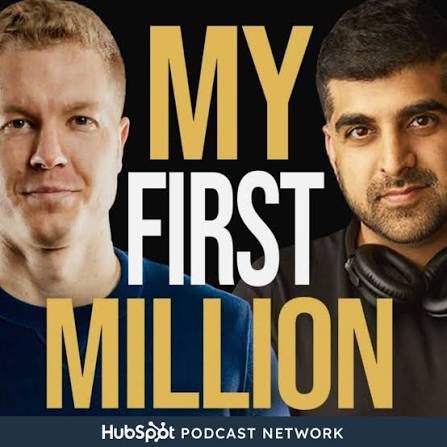
I am talking about My First Million Podcast. Sam and Shaan started brainstorming business ideas, with 1 on 1 calls with scrappy $6 mic, unstable voice and incomplete words. It was their ritual once every week.
Sam plays the more skeptical, data-driven layman role, while Shaan is the wilder, more improvisational idea-generator. They will start by pitching something dumb, then start escalation from “this is stupid!” to “wait… this might work”.
This style led them working with Tony Robbin to Syed Balkhi from WP Beginner to so many more genius minds.
They didn’t stop there. They invited all the folks in industry who knew something about creating digital businesses and scale to 8-9 figures.
They took everything from life stories to how to get into specific businesses. How they found out about these ideas? Why this idea or business? What made them stick for this many years? What are their predictions about their industry? And most importantly how can someone out there skip insecurities and start today?
If you are me, you would like to think through all the moving pieces behind their success, so does these folks are. Gosh i love how creative they are with questions on the go. Then you get into the head of in question millionaire or billionaire and walk through the finances and other vital aspects which made the journey interesting and challenging as well.
My most favorite story is from the Mohnish Pabrai on MFM about how Virgin Air started in early days and what made Richard Branson, Richard Branson.
How they cook the show (my 3 cents):
Start with old school or trending TikTok ideas or info products, roll-ups of boring businesses, and or local services, etc.
Let the “how this might be working” process flow in. Then chime in with the modern technology led solution, suggesting or understanding other persons framework and then build a stupidly simple strategy on distribution to scale this to 5 to 8 figures.
Then they would start searching what can be the possible add Ons or the current execution examples in the market that they can replicate or add a touch of any old practices from their diary of experiments with a bit of fun.
In short
They didn’t get themselves kill over “it’s not the right time” or “we are not ready yet” to get started. You never know if this is enough. You just share what you think at the moment. Now is the soon enough time to get started, and start creating a long-lasting impact in professional and personal life.
Just like those 2 nerds, i am starting this journey, I am ready to start today. Doing so to prune ideas and skills in my head into something that is readable.
Something useful that can help re-track in the future. A piece of memory and notes on thoughts posted on digital repository to get better in writing and sharing my own and possibly other’s stories (with my lens).
That’s all folks.
Allow me to close with this beautiful quote.
As Marcus Aurelius said:
“Until death, all defeat is psychological.”
The moment you accept this, everything changes.
Most setbacks or failures aren’t final, they’re just mental. Your body can keep going long after your mind has already surrendered. The real battle is always internal. Never let your mind declare defeat while you’re still breathing because “you only lose, when you give up”.
The AI renaissance is sweeping through the entire marketing strategy. The power of AI has reshaped marketers’ traditional approaches, leading us to future of marketing in the age of AI.
Artificial Intelligence (AI) is at the core of cutting-edge marketing strategies that are leading organizations into the next stage of customer engagement, personalized content creation, and data-informed decision-making.
In this write-up, we’ll be covering everything including challenges, benefits, use cases, real examples, and everything you need to know about marketing in the age of AI.
The growing adoption of AI in marketing is the next turning point. In reality, it has already had a breakthrough impact – at least the statistics support it.
51% of marketers are using AI, according to a survey of over 1000 marketers conducted by Salesforce this year (2023). Another 22% are also planning to add AI to their marketing arsenal.
Marketers have extensively used AI to achieve a wide range of objectives. Below you’ll find the marketing professional’s responses to that survey.
Almost 63% of marketers find AI helpful in analyzing market data.
Even 62% of marketers are generating marketing visual creatives with AI.
Also, 71% percent of marketing professionals say they’re receiving creative thinking support.
But, what factors are influencing marketing experts to take the help of AI?
If we look at the Salesforce study report, 71% of marketers believe that AI eliminates their busy work and helps to get more time for strategic decisions. Applying AI in marketing work can save approximately 5 hours per week.
Well, marketers are already relying heavily on AI – but, what do audiences or customers think?
Good news! Consumers have also shown positive judgment in this era of AI-based marketing. A recent survey by Capgemini Research Institutefound that about 62% of customers have no issue with the utilization of AI in marketing.
And, they shouldn’t have since one of the core goals underlying AI is to create a customer-centric marketing strategy.
So, looking at this ongoing trend, we can definitely assure you that marketing is facing a major turning point in this age of AI.
I will conclude with a question, how are we supposed to utilize AI in your marketing campaign?